
How biomarker data can save lives: highlights from the latest CONNECT webinar
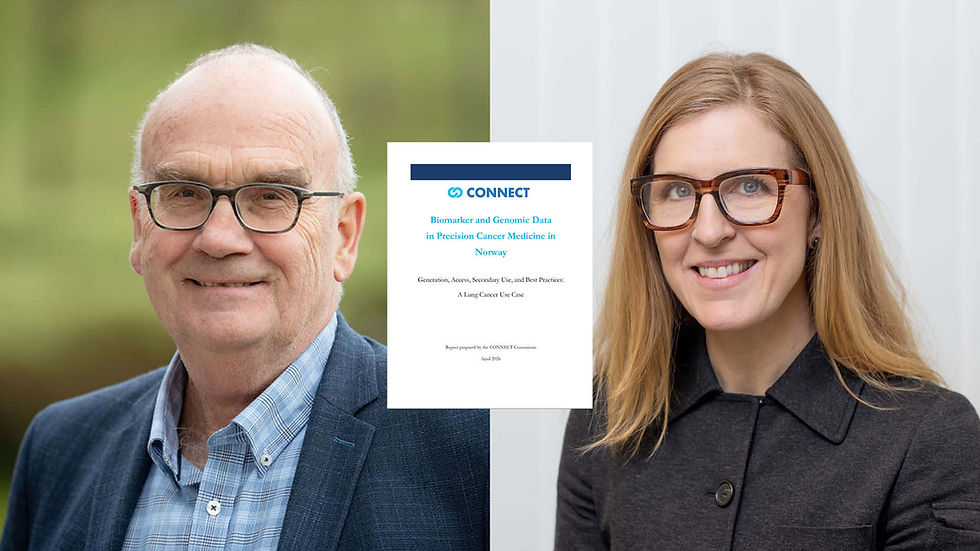
How can Norway use biomarker and genomic data more effectively to give cancer patients faster, more precise treatment?
The above question was key when CONNECT brought together experts from healthcare, research, and industry for the launch of a new report this week.
Access the report here:
CONNECT is a consortium consisting of partners from the public and private health sector working towards the implementation of precision cancer medicine in Norway.
Eimir Hurley and Steinar Thoresen, co-leads of the working group focused on health data in CONNECT, moderated the seminar.
Biomarker data for better treatments
Thoresen explained that the task was to produce a report on how diagnostics using gene profiles and biomarkers are working in Norway, how the data is reported to the Cancer Registry, and how to use the secondary data.
“We do many good things when it comes to gene profiling and diagnostics, but we are not as good at evaluating it,” Thoresen stated.
The importance of making active use of health data and including data from modern precision medicine is mentioned in the government’s recently launched action plan for clinical studies and in the mandate of NorTrials to attract clinical studies to Norway.
Biomarker and genomic data are also of importance for real-world evidence and to create control arms for clinical studies; to assist in health technology assessments; and for the European Health Data Space, innovation and industry development. In short, it can lead to better treatments and faster access to new ones.
Challenges to better data use
The report was put together by a mix of experts from across the cancer ecosystem, including Norwegian university hospitals, the Norwegian Health Directorate, the Cancer Registry of Norway and representatives of the pharmaceutical industry.
Hurley opened with a clear message: "Across the hospital ecosystem, data capture is inconsistent and unstructured."
Another challenge is that the Cancer Registry, due to technical and legal restraints, only records a very limited set of treatment-relevant biomarkers.
A third problem is that biobanks are underused: metadata are inconsistent, legacy consents restrict reuse and linkage with registries is weak.
Finally, access to secondary use is slow, and there are many bottlenecks.
“Norway possesses significant amounts of health data but still lacks systematic approaches to fully realise its potential,” Hurley commented.
Lung cancer is the main use case of the report. It includes clear lessons from the neighbouring countries Sweden, Finland, Denmark, the Netherlands and the UK on what they are doing in terms of availability of and access to the data.
Perspectives from both clinic and pharma
A variety of experts, who have contributed to the report, presented during the webinar.
Liv Marit Rønning Dørum, section leader at Cancer Registry of Norway, explained why the reuse of biomarker data in registries is important.
Sigbjørn Smeland, Head of the Cancer Clinic at Oslo University Hospital, and Haakon Skogseth, Head of Research at St. Olav's Hospital, shared the hospitals' perspectives on current challenges and future priorities.
Finally, Cathrine Notland, Country Medical Lead at Pfizer, presented how biomarker data can create value from the pharmaceutical industry’s perspective.
The discussions focused on how a more strategic use of data can improve treatment quality, research, and innovation.
Watch the webinar here:



Comments